 Elkhound
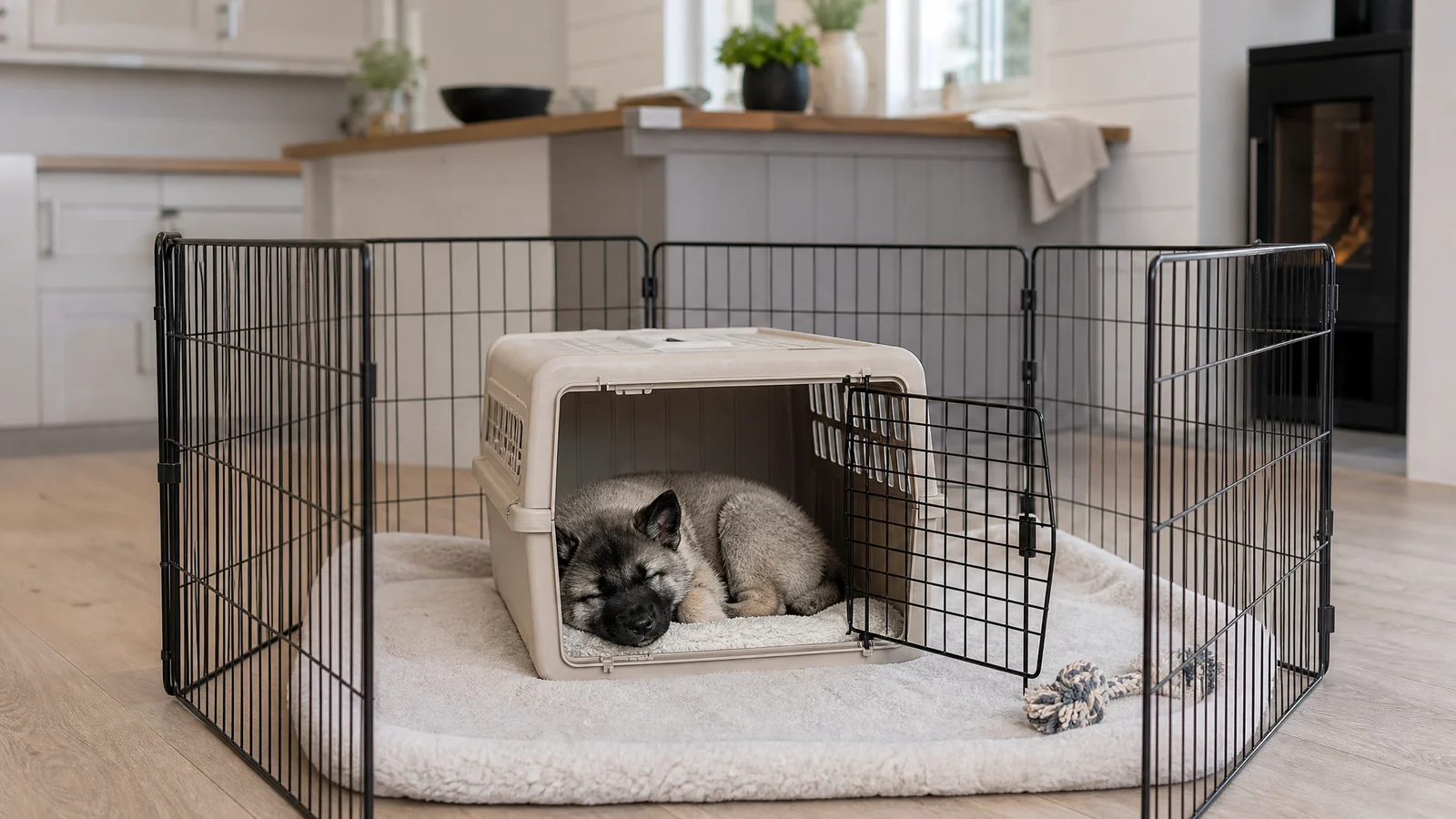
A puppy who rests in a crate while someone sits nearby has learned confinement, not yet solitude. A puppy who stays quiet for one departure may still be frozen or listening at the door. Calm alone time is measured across the whole event, including preparation, the absence and the return.
In this guide, we will choose a safe base, record an honest baseline, soften predeparture signals and build a micro-absence ladder. The next repetition comes from the puppy's recovery, not a fixed clock target. A crate can be useful, but it is never the only acceptable place to learn. We will keep confinement comfort, departure cues and actual absence on separate tracks so one hard variable does not hide another.
Crate Training and Norwegian Elkhound Alone Time
Crate training teaches the puppy to enter, rest and remain comfortable behind a door. Alone-time training teaches that people leave and return without danger. Combining both challenges too early makes it hard to know whether the barrier, the distance or the departure caused difficulty.
Build voluntary crate entry while someone remains in the room. Feed near the entrance, place rewards inside and let the puppy walk out again. Close the door only for a moment after the puppy is already relaxed, then reopen it before restlessness begins.
Practice tiny distance separately in a puppy-safe room or pen. Step behind a doorway and return while the puppy stays engaged with a safe activity. If that is easier than the crate, use the larger base for early absence work and continue crate comfort at another time.
Track which skill changes the body first. A puppy who rests with a closed crate door but follows every human movement needs distance practice. A puppy who stays relaxed when a person leaves an open pen but scratches at a closed crate needs barrier work.
The RSPCA crate guide explains that a crate should not confine a dog through a full workday. Puppies need even more frequent care, movement and bathroom opportunities. The crate is a resting place and management tool, not a solution to an unrealistic schedule.
The Norwegian Elkhound Puppy Crate Base
The best base is the least restrictive safe space where the puppy can rest. It might be an open crate inside a pen, a gated kitchen or a puppy-proof room. Choose flooring, temperature and distance from household traffic that support sleep rather than constant monitoring.
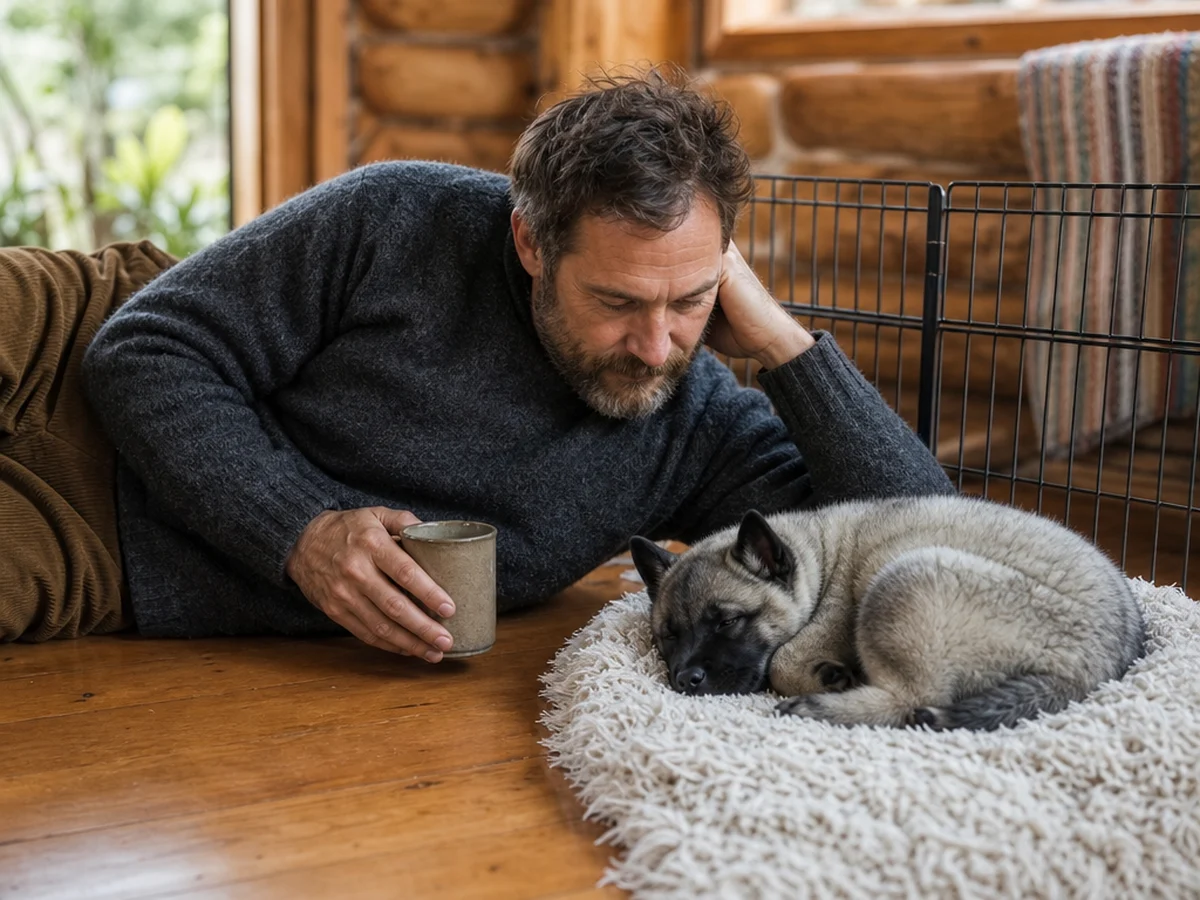
Start with a simple resting surface and watch how the puppy interacts with it before adding soft bedding. Remove collars or gear that could catch, and keep cords, plants, trash and climbable furniture out of reach. Water access and bathroom timing should match age, health and veterinary guidance.
Place the base where arrivals are not startling. A crate beside the front door may turn every hallway sound into an alert. A location too isolated may make the first separation harder. Start where ordinary household sound is present but not overwhelming.
Test the Norwegian Elkhound Crate Base
Use the base during an ordinary quiet hour before pairing it with departure. The puppy should be able to eat, shift position and rest while a person moves nearby. If the location produces constant watching, adjust sightlines or choose another room.
Exercise can support rest, but intensity is not a cure for distress. The PDSA exercise guide notes that routine may improve unwanted behavior without fixing every cause. Use age-appropriate movement, sniffing and a calm transition before practice.
A Norwegian Elkhound Alone-Time Flight Recorder
Use a camera only if it can be positioned safely and does not distract the puppy. Record one very short, ordinary absence instead of testing a limit. The useful evidence is what the puppy does before the door closes, while you are gone and after you return.
| Flight-recorder point | Calm evidence | Difficulty evidence |
|---|---|---|
| Before | Loose body, explores food, settles | Follows closely, stops eating, scans exits |
| During | Continues activity or rests | Paces, cries continuously, escapes |
| Return | Notices and resumes ordinary behavior | Cannot settle, clings or stays highly aroused |
A quiet puppy is not automatically comfortable. Stillness with a closed mouth, fixed gaze and refusal of food can signal difficulty. We want ordinary movement and the ability to engage, not simply an absence of sound.
Review the return frame too. A calm puppy may look up, stretch and return to the activity. Repeated jumping, frantic drinking or several minutes of shadowing can show that the absence cost more than the silent recording suggested.
Write the first change and the recovery time. Do not keep extending the absence until the puppy reacts. The baseline should identify an easy starting point, which may be only a few seconds with the person behind an interior door.
Predeparture Cues Before Elkhound Alone Time
Keys, shoes, a work bag and movement toward one door can predict a long absence. If the puppy becomes vigilant during preparation, the training session has already become difficult before the person leaves. Separate those signals from the full departure.
- Pick up keys, place them down and make tea.
- Put on shoes, then sit to read for a minute.
- Open the departure door, close it and remain inside.
- Walk toward the exit, then turn toward an ordinary household task.
Present only one cue at a low level and wait for ordinary behavior to return. The goal is not to repeat keys until the puppy gives up responding. It is to make small, harmless versions common enough that preparation no longer guarantees a long separation.
Keep genuine departures predictable. Meet bathroom, food, play and sleep needs first, then use a calm routine. Excited goodbyes can add contrast to the absence, while sneaking away from a vigilant puppy does not teach safety.
A Crate Training Departure Kit
Keep the camera, safe activity and necessary supplies near the base. A rushed search for keys or food can add several new signals before practice. The kit lets the person repeat the same quiet preparation and compare the puppy's response fairly.
A Norwegian Elkhound Crate Training Micro-Ladder
Begin below the baseline. If five seconds was calm, practice two or three seconds. Mix easier repetitions around any increase, and adjust a single variable between attempts. Duration, distance, door position and household sound are separate variables.
- Take one step away and return.
- Move out of sight for one second.
- Close an interior door briefly, then reopen it.
- Walk to the exterior door without leaving.
- Step outside and return before the puppy stops engaging.
- Add a small, uneven increase only after an ordinary return.
Return quietly and observe. If the puppy looks up, then resumes the activity, the repetition was likely manageable. If the puppy rushes, clings or cannot return to the activity, shorten the next absence and make preparation easier.
Pause between repetitions long enough for baseline behavior to return. A ladder built from rapid departures can create vigilance even when each absence is short. One or two calm repetitions may be more useful than a long training session.
Food as Evidence in Crate Training
A safe food toy may support the lesson, but finishing it does not prove comfort. Some puppies stop eating when worried, while others finish and then become distressed. Review the entire recording and return before the puppy reaches that change.
Do not make every absence longer. A pattern of three seconds, one second, four seconds and two seconds can build confidence without teaching the puppy that each repetition becomes harder. End after an easy success.
Repeat the same pattern on another day before adding a larger step. The puppy may respond differently after a busy morning or interrupted nap. Reliable comfort appears across ordinary variations, not only inside one carefully timed session.
Nighttime and Daytime Crate Training and Alone Time
Night and day are different contexts. Lighting, household sound, bathroom timing and human location all change. Build comfort in each setting rather than assuming a puppy who sleeps beside the bed can handle an empty daytime home.
Nighttime Crate Training
Young puppies may need proximity and bathroom trips at night. Place the crate or safe base near the sleeping person at first, respond to likely physical needs and keep trips quiet. Move the base gradually only after the puppy settles comfortably in the current location.
Move the base in small physical steps over several successful nights. If sleep fragments or the puppy begins monitoring movement, restore the last location that worked. A room change is a new difficulty even when the crate itself is familiar.
Crying immediately after lights out may reflect isolation, a bathroom need or an overtired puppy who cannot settle. Check the schedule and setup rather than waiting for escalating distress. Night comfort does not automatically transfer to daytime departures.
Daytime Alone Time
Practice when the puppy is rested and needs have been met, not only when the household must leave. Arrange care for absences longer than the current skill. The site's Elkhound puppy training guide can help balance calm exposure with adequate rest.
Adolescence can change recovery and independence. The related Elkhound training guide separates management from skill practice as privileges change. Preserve the easy alone-time steps even when the growing dog looks physically mature.
Distress Changes Norwegian Elkhound Crate Training
Repeated escape attempts, heavy panting, drooling, self-injury, prolonged vocalization or elimination unrelated to bathroom timing require a different plan. Stop increasing duration and prevent absences that exceed the puppy's current ability while help is arranged.
The Humane World guidance explains that confinement does not remove separation distress, and escape efforts can cause injury. A safe room can reduce confinement risk, but it does not by itself resolve separation distress.
Keep regular veterinary care current, and arrange a prompt appointment when behavior changes suddenly. The ASPCA separation guide explains that dogs following an alone-time plan should not be left beyond their current capacity. A veterinarian and qualified behavior professional can help distinguish distress from unmet needs and build a safe plan.
Keep the first follow-up day deliberately easy so comfort remains the strongest pattern. For the next session, repeat the easiest absence that produced an ordinary return. Record what happened before, during and after, then stop. Calm alone time grows from departures the puppy can process, not from enduring a clock target inside a closed crate.
 Puppy trainingNorwegian Elkhound Teen Months: Patience With a Bold Young Hound
 BehaviorWhy Does My Norwegian Elkhound Bark So Much at Visitors?
 Training basics“Didn't We Already Do This?” Keeping an Elkhound Engaged in Training